
Solar System Explorer
Travel across the planets and become a space scientist 🚀
Temporary player number for this tab. No name, email, country or IP address is stored.
Your Mission
Continue your journey across the solar system
Great Job!
Last 30 Days · Anonymous temporary player numbers
Our Corner of the Universe
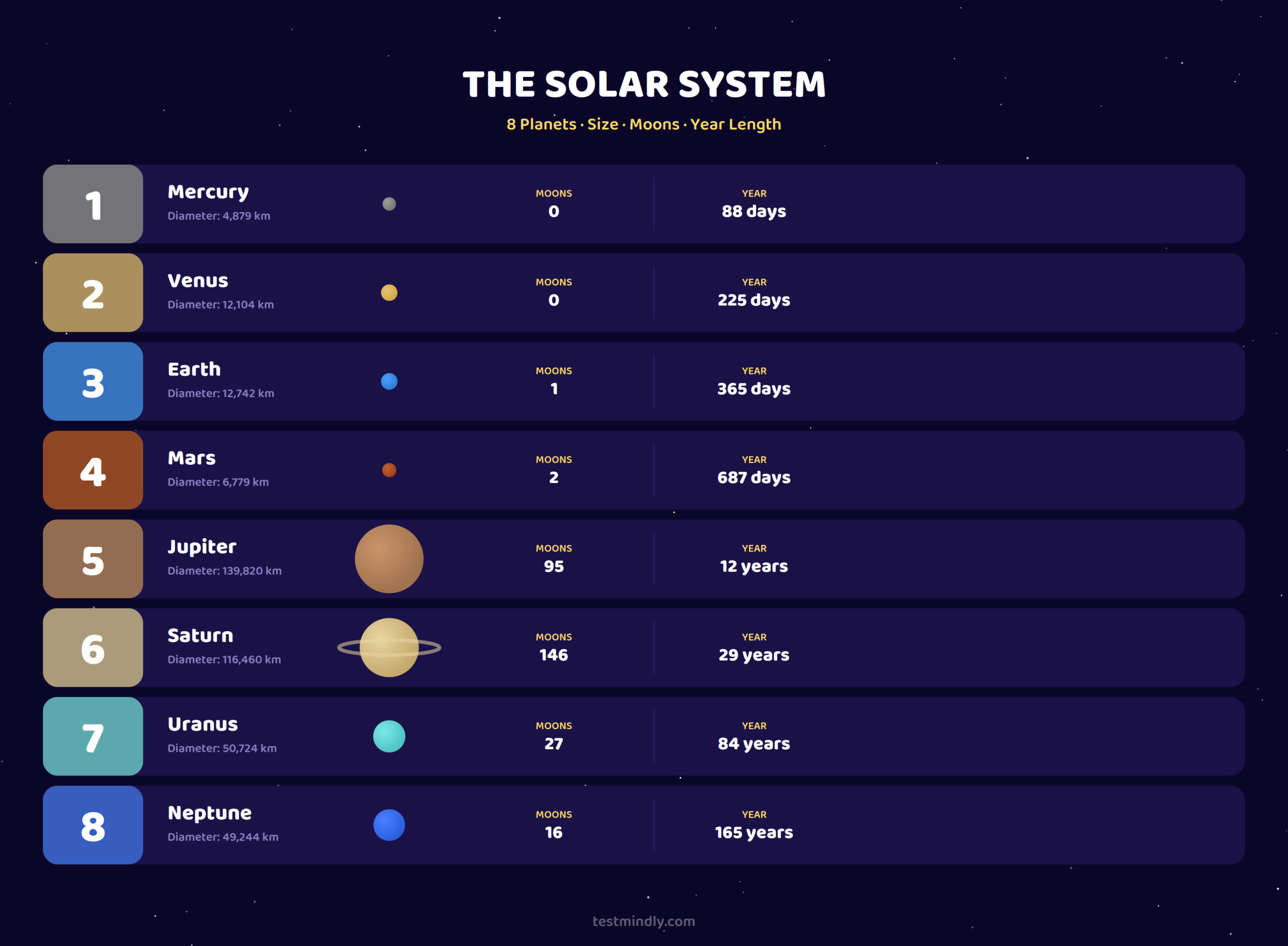
The solar system formed about 4.6 billion years ago from a collapsing cloud of gas and dust. At its centre burns the Sun — a star so massive that it contains 99.8% of all the mass in the entire solar system. Eight planets orbit it, each one a completely different world.
Planets orbiting the Sun, from tiny Mercury to massive Jupiter
Known moons across all planets combined — Saturn alone has 146
Years old — the age of our solar system, formed from collapsing gas and dust
Of all solar system mass is in the Sun — the planets share the remaining 0.2%
Solar System Chart
The 8 Planets
Mercury
The smallest planet and the closest to the Sun. Despite being nearest to the Sun, Mercury is not the hottest planet — it has almost no atmosphere to trap heat, so temperatures swing from 430°C during the day to −180°C at night. A year here passes in just 88 Earth days.
Venus
The hottest planet in the solar system — not because of its distance from the Sun, but because its thick atmosphere of carbon dioxide creates a runaway greenhouse effect, pushing surface temperatures to 465°C. Venus also spins backwards compared to most planets, so the Sun rises in the west.
Earth
The only planet known to support life. Roughly 71% of Earth’s surface is covered in liquid water — a rare condition made possible by its precise distance from the Sun, its atmosphere, and its magnetic field shielding it from harmful solar radiation. Our single Moon stabilises Earth’s axial tilt, giving us stable seasons.
Mars
The Red Planet gets its colour from iron oxide (rust) in its soil. Mars has the largest volcano in the solar system — Olympus Mons, three times taller than Mount Everest — and a canyon system, Valles Marineris, long enough to span the entire United States. Its two small moons, Phobos and Deimos, are thought to be captured asteroids.
Jupiter
The king of the planets — so massive that all the other planets combined could fit inside it. Jupiter is a gas giant with no solid surface. Its most famous feature, the Great Red Spot, is a storm that has raged for over 300 years. With 95 known moons, Jupiter has its own mini solar system — Ganymede, its largest moon, is bigger than the planet Mercury.
Saturn
Famous for its spectacular ring system — made of billions of chunks of ice and rock ranging in size from a grain of sand to a house. Saturn has 146 known moons, the most of any planet. Despite its enormous size, Saturn is so light (mostly hydrogen and helium) that it would float on water if you could find a bathtub big enough.
Uranus
The coldest planet in the solar system, reaching −224°C. Uranus is unique in that it orbits the Sun on its side — its axial tilt is 98°, meaning it essentially rolls around the Sun like a ball. Scientists believe it was knocked over by a massive collision billions of years ago. Its blue-green colour comes from methane gas absorbing red light in its atmosphere.
Neptune
The farthest planet from the Sun, taking 165 Earth years to complete one orbit — meaning one Neptune year is longer than all of recorded human history. Neptune has the fastest winds in the solar system, reaching over 2,000 km/h. It was the first planet discovered through mathematics rather than direct observation, predicted before it was ever seen through a telescope.
5 Things That Will Change How You See Space
The Sun is enormous beyond imagination
1.3 million Earths could fit inside the Sun. If you drove a car at highway speed directly toward the Sun, it would take over 170 years to arrive. Yet the Sun is classified as a medium-sized, perfectly ordinary star — there are stars thousands of times larger.
Light from the Sun is already 8 minutes old
Sunlight takes about 8 minutes to reach Earth. So when you look at the Sun, you are seeing it as it was 8 minutes ago. Light from Neptune takes over 4 hours. Light from the nearest star beyond the Sun takes 4.2 years.
Space between planets is mostly empty
If you shrank the solar system so Earth was the size of a marble, the Sun would be about 2.5 metres away. Jupiter would be 13 metres away, and Neptune would be 150 metres off. Everything between those points is vacuum.
A day on Venus is longer than its year
Venus rotates so slowly (243 Earth days per rotation) that its day is actually longer than its year (225 Earth days per orbit). This means that on Venus, the Sun rises roughly once every Venusian year.
Frequently Asked Questions
How many planets are in the solar system?
Eight officially recognised planets: Mercury, Venus, Earth, Mars, Jupiter, Saturn, Uranus, and Neptune. Pluto was reclassified as a dwarf planet in 2006 by the International Astronomical Union, as it hasn’t cleared its orbital neighbourhood of other debris.
Which is the biggest planet?
Jupiter — by a wide margin. Its diameter of 139,820 km means it is over 11 times wider than Earth. All the other planets in the solar system could fit inside Jupiter at the same time.
Which planet has the most moons?
Saturn currently holds the record with 146 confirmed moons as of 2023, surpassing Jupiter’s 95. Moon counts change as new discoveries are made — both planets have dozens of small, irregularly shaped moons captured from the asteroid belt.
Why is Mercury not the hottest planet if it’s closest to the Sun?
Mercury has virtually no atmosphere, so it cannot trap heat. When facing the Sun temperatures soar, but the heat escapes immediately on the night side. Venus, with its thick atmosphere of carbon dioxide, traps heat so effectively that its surface stays at 465°C day and night — making it far hotter than Mercury despite being farther from the Sun.
Could humans live on another planet?
Not yet. Mars is the most realistic candidate — it has a day length similar to Earth’s, some frozen water, and a comparable distance from the Sun. But its atmosphere is thin (mostly CO₂), it has no global magnetic field to protect against radiation, and surface temperatures average −60°C. Significant terraforming or enclosed habitats would be required.
Explore every planet up close
Scroll back up and start your Solar System journey!