
English Level Test — CEFR Estimate
Estimate your CEFR level from A1 to C2 with a short adaptive test covering grammar, vocabulary, and listening.
This is an informal placement estimate, not an official CEFR certificate.
What Is Your English Level? Get a CEFR Estimate
This free adaptive quiz estimates your CEFR level through grammar, vocabulary, and short listening-recognition questions. It is designed as a quick study guide, not an official language certificate.
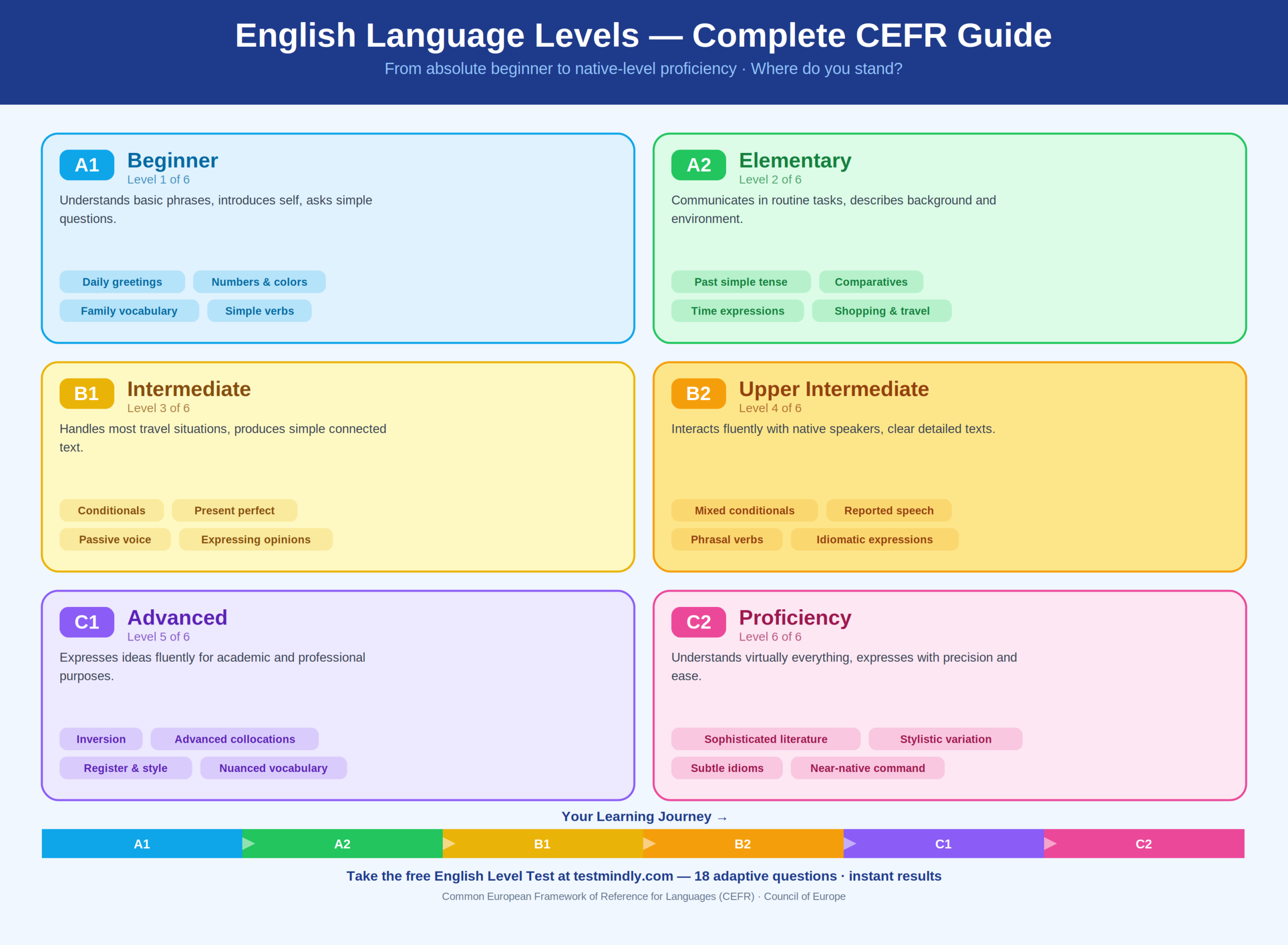
A simple guide to the six CEFR reference levels, from basic user to proficient user
Your result is an informal CEFR estimate based on the question types included in this quiz. It does not directly assess speaking, writing, or extended reading, and it should not be used as an official certificate.
The Six CEFR English Levels Explained
The Common European Framework of Reference for Languages, usually called CEFR, describes language ability across six broad levels. These descriptions explain the wider framework; this short quiz estimates where your current grammar, vocabulary, and listening-recognition performance may fit.
A1 Beginner
You can understand and use familiar everyday expressions and very basic phrases.
- Greetings and introductions
- Numbers, colors, and dates
- Basic forms of “be” and “have”
- Simple present sentences
A2 Elementary
You can understand frequently used expressions and communicate in simple, routine situations.
- Past simple forms
- Comparatives and superlatives
- Shopping, travel, and directions
- Common linking words
B1 Intermediate
You can understand the main points of clear language on familiar topics and handle many everyday situations.
- First and second conditionals
- Present perfect forms
- Common passive structures
- Expressing reasons and opinions
B2 Upper Intermediate
You can understand more complex ideas and communicate with greater fluency and detail.
- More complex conditionals
- Reported speech
- Phrasal verbs and collocations
- Clear, detailed explanations
C1 Advanced
You can understand demanding language and express ideas fluently, flexibly, and with good control.
- Inversion and emphasis
- Advanced collocations
- Register and stylistic choice
- Complex sentence structures
C2 Proficient
You can understand highly complex language and express meaning with precision, flexibility, and nuance.
- Subtle meaning and implication
- Idiomatic and figurative language
- Flexible use of different registers
- Precise and natural expression
How the English Level Estimate Works
This quiz uses an adaptive question flow. Your answers influence the difficulty of later questions, while the final estimate considers your overall performance and the difficulty levels of the questions you answered. It is a practical screening tool rather than a formally calibrated language examination.
📐 Adaptive Question Flow
Correct and incorrect answers help the quiz choose more suitable questions as you continue. This creates a shorter and more relevant experience than presenting every user with the same fixed sequence.
📚 Three Question Categories
The quiz includes Grammar, Vocabulary, and Short Listening Recognition. Listening items use your device’s text-to-speech feature and do not replace a complete listening-comprehension assessment.
🏦 74-Question Bank
The current question bank contains 74 items across A1–C2 difficulty bands. Each attempt uses 18 questions, so different attempts may present a different path through the test.
📊 Detailed Result Screen
Your result includes an estimated CEFR band, score, accuracy, category breakdown, study recommendation, and answer review. Use these details to identify what to practise next.
How to Improve Your English — Practical Tips
Use understandable listening and reading material
Choose podcasts, videos, short articles, or graded readers that are challenging but still understandable. Regular exposure helps you notice vocabulary, grammar, and natural sentence patterns in context.
Produce a little English every day
Write a short journal entry, describe your day, record a voice note, or answer a simple question in English. Active use helps reveal gaps that passive study may not show.
Work on the weakest category shown in your result
If grammar, vocabulary, or short listening is noticeably lower than the other categories, give that area extra practice while continuing to use English as a whole.
Retest after a meaningful period of practice
Language progress is gradual and varies from person to person. Retesting after several weeks can help you compare results, but a single score should not be treated as a complete measure of your ability.
Frequently Asked Questions
Is this English level test free?
Yes. The test is free to use, and no sign-up or email address is required. You can take it again whenever you want to compare your performance.
Is this an official CEFR test?
No. It is a CEFR-aligned online estimate based on grammar, vocabulary, and short listening-recognition questions. It is not an official certificate and does not replace an accredited language examination.
How accurate is the estimated level?
The result can provide a useful starting point for study, but its accuracy is limited by the short format and the skills covered. Speaking, writing, and extended reading are not directly assessed, so your full language profile may differ from the displayed level.
What is the difference between B1 and B2 English?
B1 users can usually handle familiar everyday situations and express connected ideas on common topics. B2 users generally understand more complex material and communicate with greater fluency, detail, and independence. Actual ability can vary across listening, reading, speaking, and writing.
Which English level do employers require?
Requirements vary by role, employer, country, and the amount of English used at work. B2 is often useful for international communication, while some academic or highly language-dependent roles may expect C1. Always check the specific requirement for the position.
How long does it take to move up one CEFR level?
There is no universal timetable. Progress depends on your starting point, study quality, practice frequency, exposure to English, and the skills you are developing. Regular, focused practice is more useful than relying on a fixed number of weeks or months.
Does the test include listening questions?
Yes. Some items use your browser’s text-to-speech feature for short listening-recognition tasks. These questions sample a limited listening skill and should not be treated as a full assessment of real-world listening comprehension.
What should I do after getting my result?
Review the category breakdown and answer explanations, identify the area that needs the most attention, and choose practice material close to your estimated level. Treat the result as a study guide rather than a permanent label.
Ready to Estimate Your English Level?
18 adaptive questions · Grammar, Vocabulary & Short Listening · Instant CEFR estimate · Free to use
📝 Take the Test Now