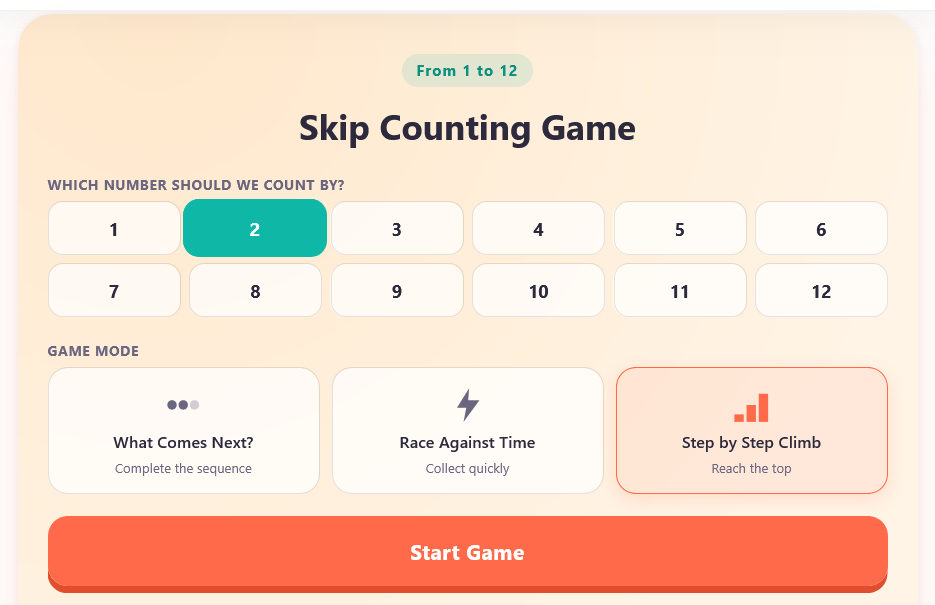
Skip Counting Game
Done!
Add your score to the leaderboard?
No name or personal information is collected. This score will use TM Player ------. It stays the same while this tab is open and is not saved as a permanent device identity.
Leaderboard
Anonymous scores are automatically deleted after 30 days.
- Loading…
What Is Skip Counting — and Why Does It Matter?
Skip counting means counting forward by the same number every time instead of by ones — like 2, 4, 6, 8. It’s one of the very first patterns kids learn on the road to multiplication, because every times table is really just a skip-counting sequence in disguise.
Builds number sense. Kids start seeing patterns instead of memorizing isolated facts.
Speeds up mental math. Counting coins, minutes, or objects in groups becomes fast and automatic.
Sets up multiplication. Knowing the count-by-7 pattern means the 7-times table is mostly already learned.
Shows up in real life — counting money in 5s and 10s, telling time in 5-minute jumps, eggs by the dozen.
How to Memorize Skip Counting
Say it out loud, with rhythm. Clap, tap, or stomp on every number — the body remembering the beat helps the brain remember the sequence.
Use a number line or hundred chart. Color in every number you land on — the visual pattern sticks better than digits alone.
Practice in short, frequent bursts. Two minutes a day beats one 20-minute session — rhythm needs repetition, not cramming.
Connect it to something physical. Fingers and toes for 2s, 5s and 10s; egg cartons for 6s; pairs of shoes for 2s.
Spot the pattern in the last digit. By 2 always lands on an even number. By 5 always ends in 0 or 5. By 10 always ends in 0.
Turn it into a game. Active recall under a little time pressure — like in the Skip Counting Game above — locks it in far better than passive repetition.
Skip Counting Chart
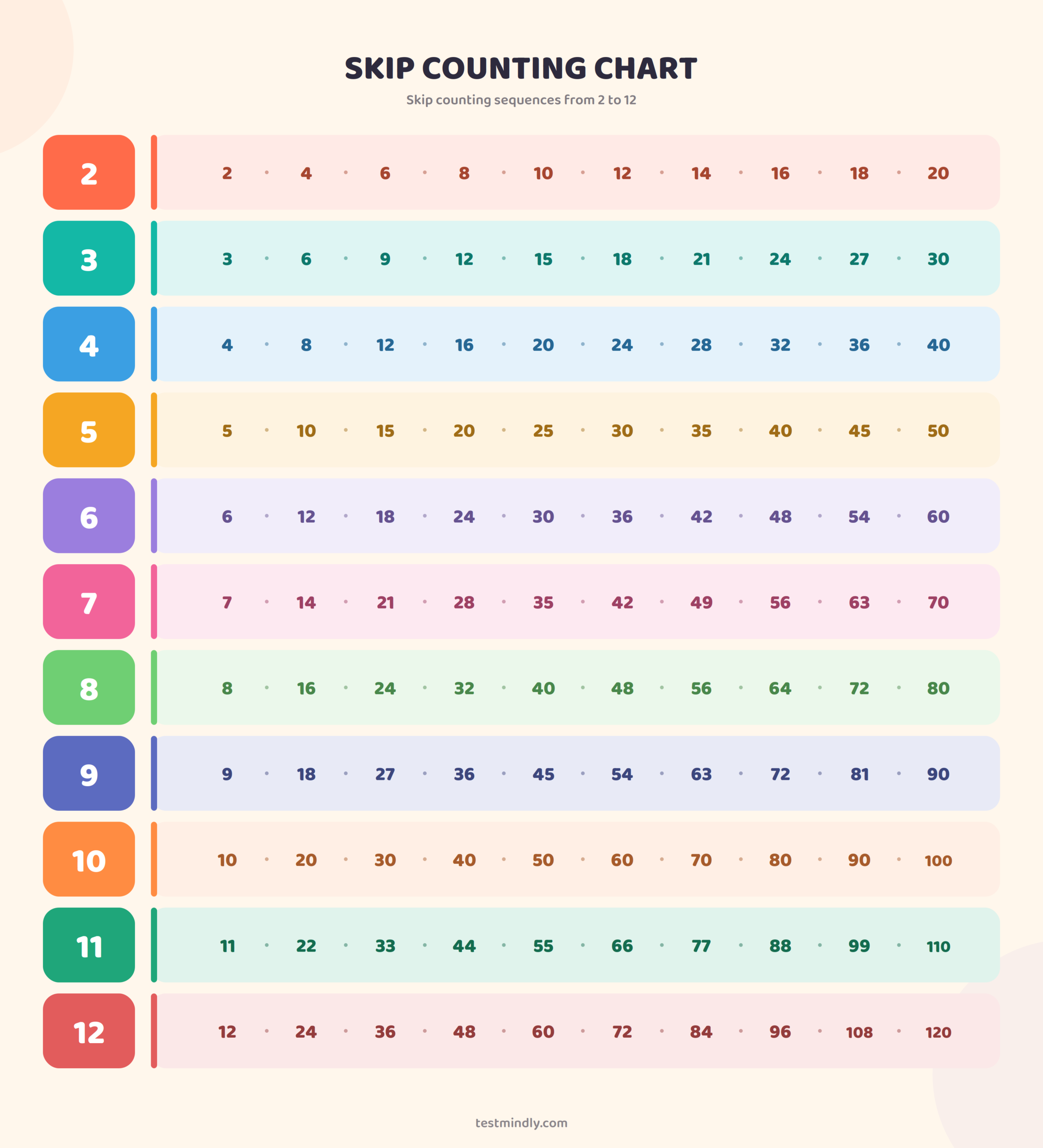
Skip Counting Sequences (2 to 12)
2, 4, 6, 8, 10, 12, 14, 16, 18, 20
3, 6, 9, 12, 15, 18, 21, 24, 27, 30
4, 8, 12, 16, 20, 24, 28, 32, 36, 40
5, 10, 15, 20, 25, 30, 35, 40, 45, 50
6, 12, 18, 24, 30, 36, 42, 48, 54, 60
7, 14, 21, 28, 35, 42, 49, 56, 63, 70
8, 16, 24, 32, 40, 48, 56, 64, 72, 80
9, 18, 27, 36, 45, 54, 63, 72, 81, 90
10, 20, 30, 40, 50, 60, 70, 80, 90, 100
11, 22, 33, 44, 55, 66, 77, 88, 99, 110
12, 24, 36, 48, 60, 72, 84, 96, 108, 120
Frequently Asked Questions
What grade do kids learn skip counting?
Skip counting by 2s, 5s, and 10s is usually introduced in 1st and 2nd grade, with the full range up to 12 building through 2nd and 3rd grade as multiplication is introduced.
Is skip counting the same as multiplication?
Not quite, but it leads straight into it. Skip counting by 4 five times (4, 8, 12, 16, 20) is the same as 4 × 5 = 20 — skip counting is multiplication in slow motion.
What’s the easiest way to practice at home?
A short daily routine works best: a minute of saying the sequence out loud, a number line to point at, and a quick round of the Skip Counting Game to test what stuck.
Ready to put these patterns into action?
Scroll back up and try the Skip Counting Game above!